
What Is Product Handling? The Foundation Of High-Quality Codes For Traceability

What Is Product Handling? The Foundation Of High-Quality Codes For Traceability
A new dimension in barcodes
Two-dimensional barcodes are increasingly finding their way onto product packaging. Factors such as globalization, online trading, and the need for more robust anti-counterfeit methods are driving the adoption of these codes. In certain industries, such as European tobacco and pharmaceuticals, 2D codes have become a regulatory requirement.
The success of 2D codes is evident, and in May 2020, the global standard organization GS1 initiated a campaign to support the integration of 2D codes at the point of sale (POS) through a new barcoding standard known as GS1 Digital Link. This standard aims to facilitate the use of 2D codes at point-of-sale systems and enable a gradual shift away from traditional linear barcodes.
There are several advantages to opting for 2D codes over traditional linear barcodes. 2D codes allow for the inclusion of more information within a single code, including dynamic data, and can support serialization and broader traceability. However, the intricate nature of 2D codes also presents certain challenges.

The challenges behind 2D codes
Ensuring the accurate printing of 2D codes is essential to guarantee effective scanning, especially when employing these codes for regulatory reasons, such as in the fields of tobacco, pharmaceuticals, or medical devices. This becomes increasingly vital when contemplating the use of 2D codes at the point of sale (POS).
Variable 2D codes introduce a specific challenge, as the dynamic data may necessitate coding products that are already packed or filled. Merely adding a coding device to an existing production line may not be the most optimal solution, as production machinery is often not initially designed with coding considerations in mind.
What is product handling?
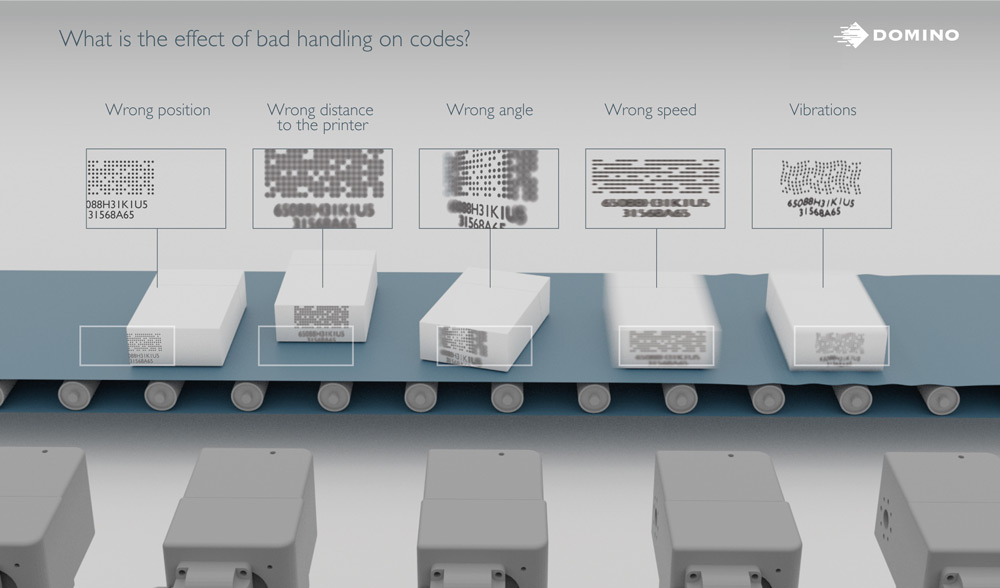
The way products are handled or presented to the coding device plays a crucial role in achieving top-notch codes. Manufacturers opting to code products in-line without efficient product handling may experience variations in the production line, potentially impacting the quality of the final code. This may encompass:
- Product position:Slight deviations in the product’s positioning can lead to codes being applied in the incorrect area or result in missing or incomplete codes.
- Product distance from the printer: Being too close or too far from the coding device during positioning can lead to codes that are blurry or unreadable.
- Product angle: Even a slight rotation in the positioning of the product, even if it’s just a few degrees, can lead to distorted codes.
- Line speed: Even slight fluctuations in speed will impact the code’s quality, resulting in compressed or elongated codes.
- Conveyor vibrations: At elevated speeds, even slight vibrations can influence the quality of the code, resulting in codes of low quality, appearing blurred, or exhibiting waviness.
- Challenging product geometry: Some packaging formats can pose difficulties for a conventional coding arrangement.
At the very least, insufficient product handling leading to a low-quality 2D code can result in a significant number of rejections, rework, and defective stock. In addition, subpar 2D codes can adversely impact production lines that necessitate the aggregation of serialized products. The consequences can be more severe if an undetected unreadable 2D code leaves the factory. Brands may encounter substantial fines, loss of business, product recalls, and potential legal ramifications.
What’s the solution?
A customized product handling solution can address all the previously mentioned issues related to code quality by ensuring the ideal and consistent delivery of products to the coding equipment. The ideal solution will be crafted taking into account various factors, including:
- Product and packaging type: Elements like the form of packaging, the type of substrate, and the weight of a filled package can be pivotal. While cigarette packs are light and have a uniform shape, coding beverage cans poses a greater challenge.
- Code requirements: The type of code, its placement, and its resolution play significant roles. Numerous machine-readable codes have specified minimum size requirements and demand the utilization of high-resolution printing technologies.
- Existing production specifications:When incorporating a coding solution into an existing production line, it must be tailored to adhere to the existing specifications to avoid impeding production speed or diminishing Overall Equipment Effectiveness (OEE).
Given the factors mentioned earlier, a customized solution may employ various types of technology to manage finished products and deliver them to the selected coding device for the final printing.
Depending on the product type, this might involve robotic arms, specialized conveyors, wheels, or product carriages and movers. These devices can employ diverse methods for product handling, applying varying levels of force suitable for delicate and robust products alike. A tailored handler could be designed with pneumatic or servo-electric driven side or ‘Top & Bottom’ belts, as demonstrated in Domino’s handling solution for pharmaceuticals and tobacco, or even magnetic or vacuum solutions.
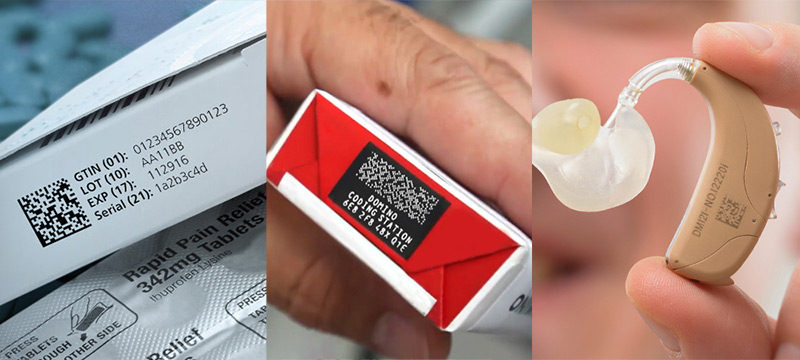
In addition to enhancing the overall quality of codes, customized product handling solutions can be designed to facilitate additional processes for pre- or post-treatment of a substrate as needed. When employed in conjunction with machine vision systems, these solutions can provide crucial information for operations monitoring. The handling system will typically incorporate an automated rejection device and can be utilized for other non-coding needs. An illustrative instance is the ‘Tax Stamp Verification’ feature on the Coding Station, ensuring the correct application of a Tax Stamp. The same rejection device can then be repurposed for either process.
CASE STUDY: Domino Cigarette Pack Coding Station
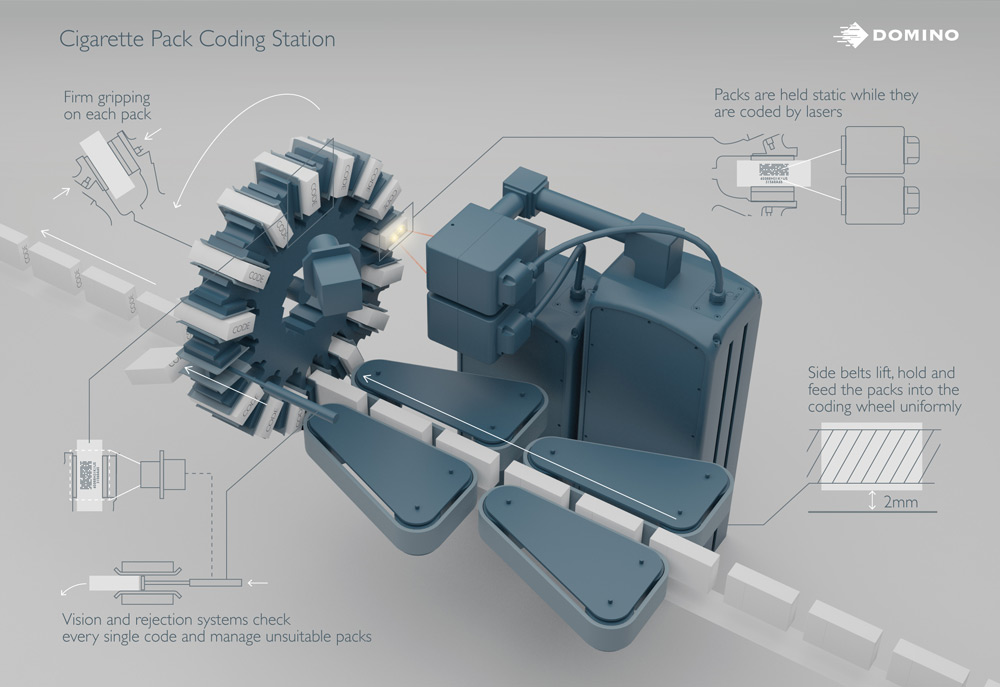
The Domino Cigarette Pack Coding Station (CPCS) is a product handling solution developed for dynamic laser coding of 2D track and trace (T&T) DotCodes on standard, soft, and hard cigarette packs.
The challenge:
Cigarette packs must adhere to stringent regulatory standards, requiring the application of high-quality, high-definition T&T DotCodes consistently to the bottom of each pack. However, this poses a challenge with certain Original Equipment Manufacturer (OEM) equipment, as the pack base may not be easily accessible or located in a position on the machine that hinders effective coding. Despite the need for static coding, the high speeds of cigarette production lines, reaching up to 500 packs per minute, cannot be compromised.
Learn more about the CPCS Here
Conclusion
When imprinting codes directly onto product packaging, it is crucial to assess whether products can be sufficiently coded in their current position or if a product handling solution is necessary. Implementing product handling solutions, like those offered by Domino Solutions, contributes to enhancing the overall quality of codes on the production line. This assists manufacturers in enhancing Overall Equipment Effectiveness (OEE) by minimizing waste, boosting production efficiency, and reducing overall operational expenses.